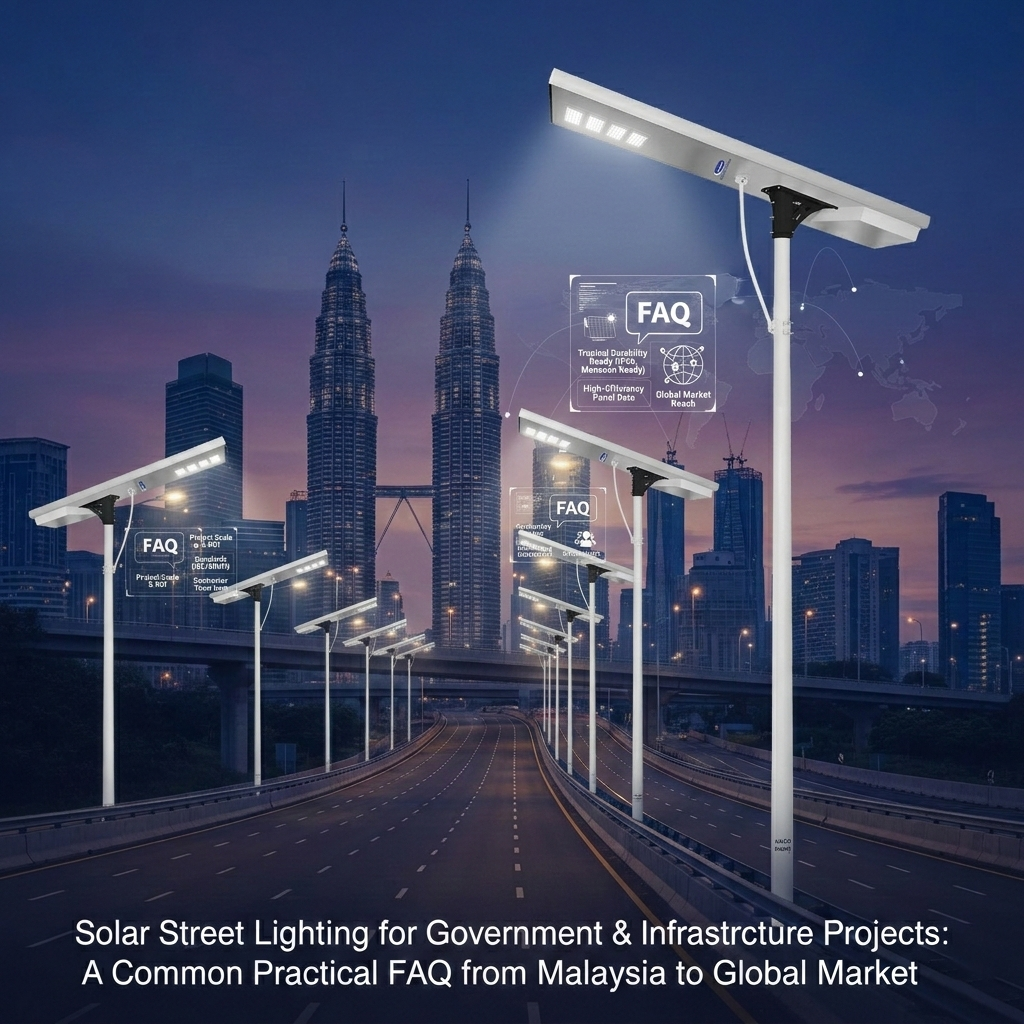
Solar Street Lighting for Government & Infrastructure Projects:
A Common Practical FAQ from Malaysia to Global Market

David Chew
Vice President, Sales & Marketing
January 29, 2026
Author: David Chew
FAQ: Malaysia Market (Focus: JKR & Local Reliability)
1. Which solar street light brands are compliant with JKR JMAL/EMAL standards?
Our products are listed on the JKR JMAL/EMAL (Electrical Material Approved List), ensuring they meet the specific technical and safety requirements for Malaysian public infrastructure.
2. What are the advantages of sourcing from a domestic Malaysian factory?
Sourcing locally ensures compliance with Ministry of Finance (MOF) local content policies and MyHijau compliances to local green label policies, we provides on-site technical support, and eliminates the long lead times associated with overseas shipping.
3. How does your product meet JKR lumen efficacy requirements?
We provide high efficiency systems delivering up to 180-200lm/W, exceeding the standard JKR requirements for brightness and energy conservation on public roads.
4. Are your products SIRIM and Suruhanjaya Tenaga (ST) certified?
Yes. All units undergo rigorous testing for IP66 (water proofing) and IK08 (impact resistance), ensuring they meet Malaysian national safety and performance benchmarks.
5. How are your solar lights engineered for the tropical Malaysian climate?
PMW systems are designed with high-temperature tolerant LiFePO4 batteries and specialized casings to handle constant humidity and 35-40’c ambient temperatures.
6. Can your poles withstand high wind loads in coastal regions like Sarawak or Terengganu?
Our pre-stressed spun concrete poles are engineered for wind-load resistance of up to 35m/s, providing a stable foundation for solar arrays in monsoon-prone coastal areas.
7. Do you provide local warranty and maintenance support for PBT projects?
Yes. Being a local manufacturer, we offer a 5-year local warranty and have spare parts available, ensuring minimum downtime for municipal (PBT) lighting projects.
FAQ: Overseas Solar Street Light Project Supply
1. What is the maximum battery autonomy for your high-capacity solar lights?
Our systems offer up to 3-5 days of autonomy (backup power), we design and produce according to your needs, ensuring consistent lighting even during heavy rain or extended cloudy weather in international markets.
2. How do you calculate the correct battery-to-panel ratio for tenders?
We use advanced solar modeling to ensure the battery capacity (Wh) is perfectly matched to the panel’s daily harvest, preventing deep discharge and extending system life.
3. Why do you use Grade A LiFePO4 battery cells?
We prioritize Grade A Lithium Iron Phosphate cells for their longer lifespan and safety, offering significantly better thermal stability than the cheaper Ternary Lithium recycle or used cells found in mass-market units. Which usually design for low capacity like rated 3.2v
4. Are your systems compatible with Smart City IoT monitoring?
Yes. Our lights can be integrated with Zigbee or LoRaWAN controllers, allowing government agencies to monitor battery health and dimming schedules from a central dashboard.
5. What is the solar conversion efficiency of your panels?
We utilize N-type Monocrystalline cells with an efficiency of 22.5%+, ensuring maximum power generation even in limited daylight conditions.