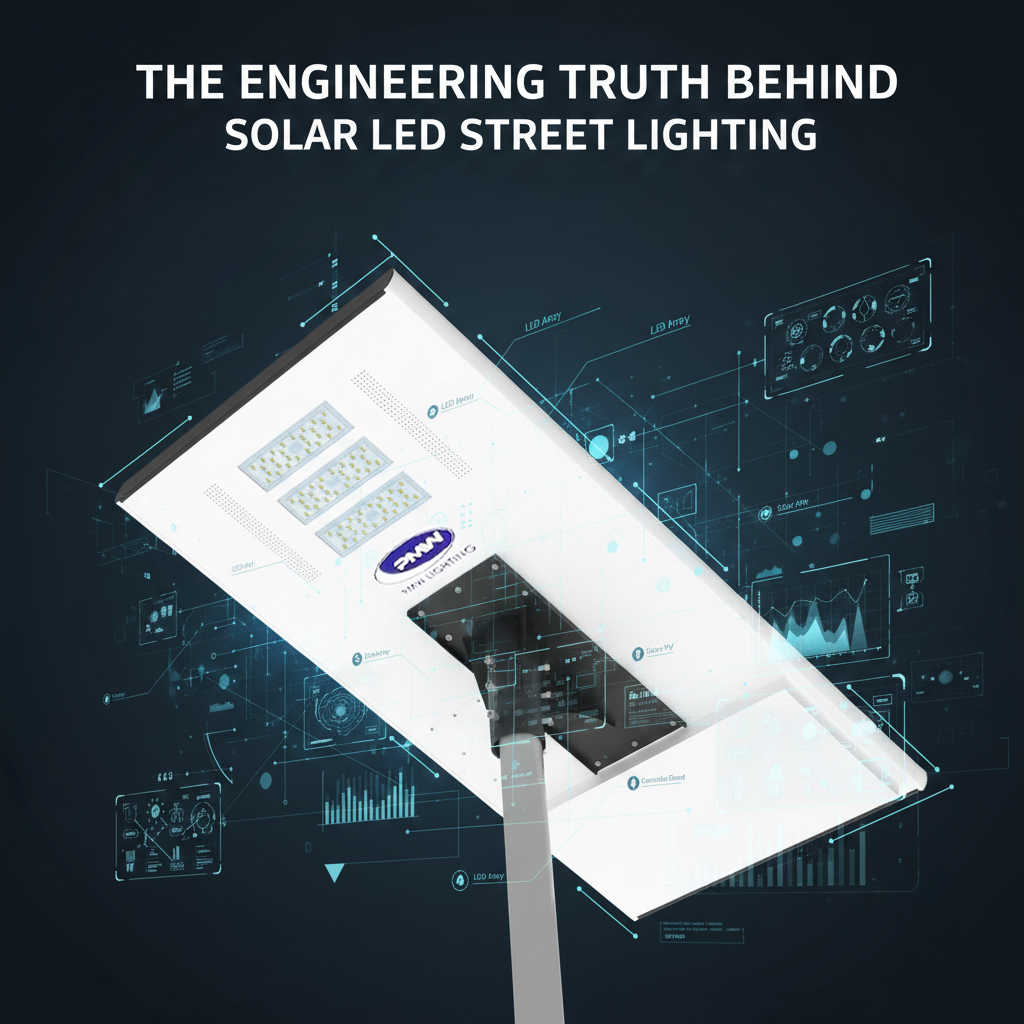
The Engineering Truth Behind Solar LED Street Lighting

David Chew
Tittle: Physics vs. Marketing: Why “Wattage” is a Myth and Lumens/Battery Capacity are Reality
February 2026
Author: David Chew
1. Executive Summary
The global solar street light market is currently flooded with products boasting inflated
specifications—often labeled as 200W, 500W, or even 1000W—sold at prices that do
not cover the raw material cost of genuine components. This paper deconstructs the
physical relationship between LED power, battery storage, and solar panel collection.
Using a 120W LED standard, we provide the exact formulas needed to verify a light’s
performance and explain why Lumens, not Watts, is the only valid metric for brightness
evaluation.
2. The Great Wattage Deception
On platforms like Shopee and Lazada, “Wattage” has been hijacked as a marketing
buzzword. Sellers often use “LED Wattage” (the theoretical max of the LED chips) rather
than “System Wattage” (the actual power consumed).
How to Spot a “Fake” Spec:
· The Weight Rule: High-capacity LiFePO4 batteries are heavy. If a “500W” light weights
only 3kg, it is physically impossible for it to contain the battery required to power that
wattage.
· The Price Paradox: If the retail price is lower than the wholesale cost of a Grade-A
100Ah battery, the light is a fake.
· The Panel Size: A 120W solar panel is roughly $0.7m2. If the light’s panel is the size of
an iPad, it cannot generate more than 15-20W of power.
3. Engineering the 120W Standard: Battery Design
To ensure a 120W LED light performs reliably, we must calculate the required Watthours
(Wh) for a full night’s operation.
Step 1: Daily Energy Consumption
If a 120W light runs at 100% brightness for 12 hours:
20W x 12h = 1,440Wh
Step 2: Battery Sizing (The “Heart” of the System)
We use Lithium Iron Phosphate (LiFePO4) for longevity. To protect the battery, we never
discharge it to 0%. We use a Depth of Discharge (DOD) of 80% and account for
controller efficiency (approx. 90%).
The Formula:

For a 120W light (1 day autonomy):

To find Ampere-hours (Ah) for a 12.8V system:

Technical Insight: Most “Shopee 120W” lights only carry a 20Ah to 30Ah battery. This
means they are actually running at only 15W to 20W real power.
4. Solar Panel Sizing: The 4-Hour Recharge Rule
A professional solar light must replace 100% of its used energy during the limited “Peak
Sun Hours” (PSH) of the day. For most regions, we design for a 4-hour window.
Step 3: Solar Panel Calculation
To recharge 1,440Wh in 4 hours, accounting for charging losses (approx. 25% loss due to heat and conversion):
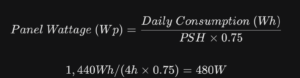
The Verdict: A true 120W street light that runs at full power all night requires a 480W solar panel. This is why professional lights are “Split Type” (separate panel and light), as no “All-in-One” housing is large enough to hold a 480W panel.
5. Why Lumens > Wattage
In the LED era, Wattage measures what you pay for (energy), but Lumens measure what you get (light).
The Efficiency Gap
Two different 120W lights can have vastly different brightness levels based on their
Luminous Efficacy (lm/W):
· Low Quality: 80 lm/W → 9,600 Lumens
· High Quality (Lumileds/CREE): 170 lm/W → 20,400 Lumens
Note: At PMW Lighting, 200lm/w Solar Street Light is available.
A buyer looking only at “120W” might buy a light that is 50% dimmer than a professional 80W light with high efficacy.
Rule of Thumb: Always ask for the IES test report or the total Luminous Flux (lm). If a seller cannot provide it, the wattage is likely a guess.
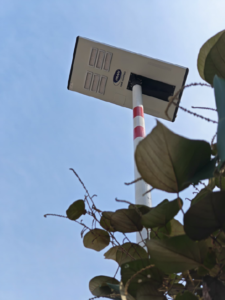
PMW 120W Solar LED Street Light on Color Coated Concrete Pole
6. Conclusion: A Professional Buyer’s Checklist
When evaluating a solar street light, follow these three steps to filter out the fakes:
1. Check Battery Wh: Multiply the Vx Ah on the spec sheet. If it’s less than 10x the
“Wattage,” the light will dim within 2 hours.
2. Measure the Panel: A real 120W light needs a panel at least 1 meter long.
3. Demand Lumens: Look for a rating of at least 150 lm/W.
#SolarStreetLight #PmwLighting #SolarTruth #BatteryDesign
WHITE PAPER: The Engineering Truth Behind Solar LED Street Lighting