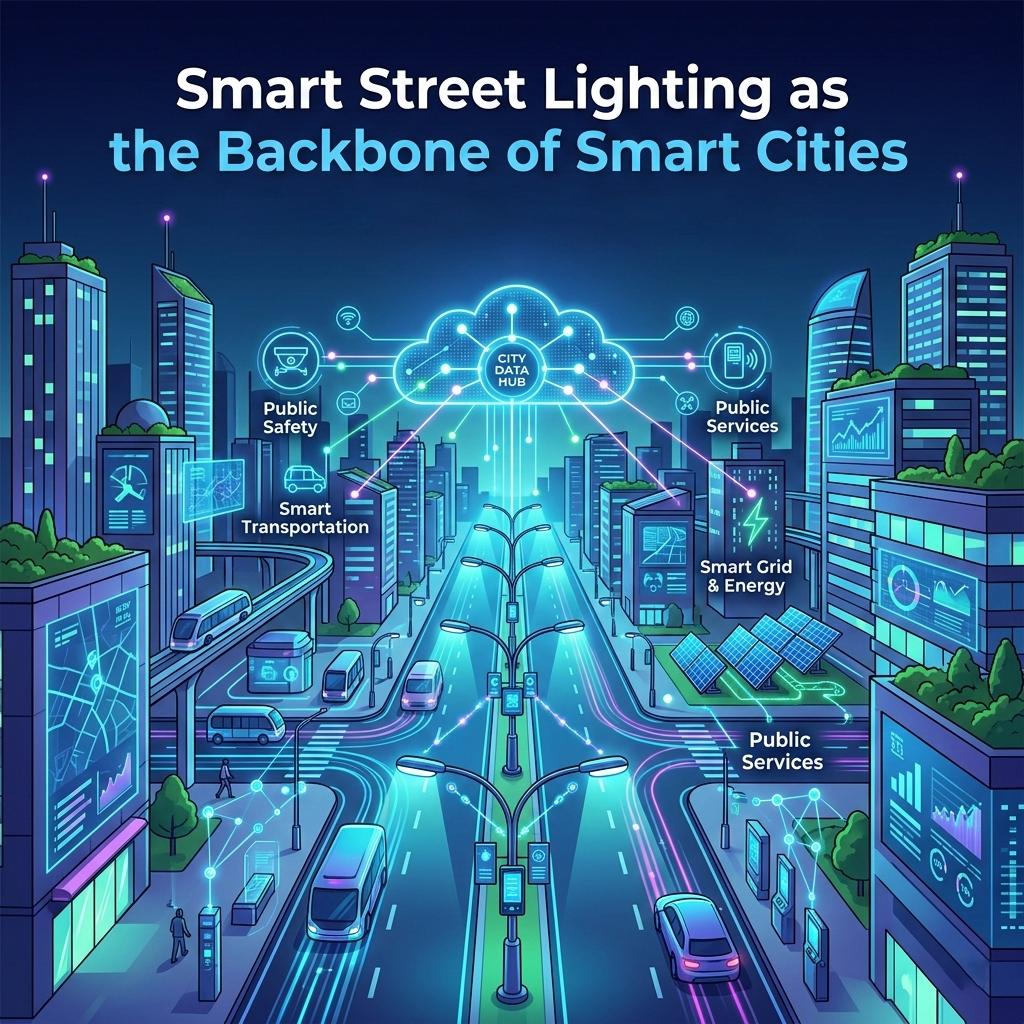
Smart Street Lighting as the Backbone of Smart Cities
Why Governments Worldwide Are Transitioning to Smart Lighting Infrastructure
Executive Summary
Cities across the world are undergoing a structural transformation driven by urbanization, fiscal pressure, climate commitments, and rising citizen expectations. Governments are increasingly expected to deliver safer streets, lower operating costs, improved public services, and measurable sustainability outcomes—often with constrained budgets and aging infrastructure. In this context, smart street lighting has emerged as one of the most effective and pragmatic entry points into smart city development.
Smart street lighting is no longer simply about illumination. It is a digital, energy, and data infrastructure that supports public safety, operational efficiency, environmental sustainability, and future smart city applications. As a result, governments in both developed and emerging economies are accelerating the adoption of smart lighting systems as a foundational layer of their smart city strategies.
This white paper explains why smart street lighting has become a priority for governments, how it delivers tangible economic and social benefits, and why it is often the first large-scale smart infrastructure investment cities choose to implement.
1. The Global Shift Toward Smart Cities
Urban areas now host more than half of the world’s population, and this proportion continues to rise. With increasing density comes higher demand for public services, transportation, safety, energy, and environmental management. Traditional urban infrastructure—designed decades ago—was never intended to support today’s scale, complexity, or sustainability requirements.
Smart cities represent a response to this challenge. Rather than expanding infrastructure endlessly, governments are increasingly using digitalization, automation, and data-driven decision-making to improve how cities operate. Smart cities integrate physical infrastructure with sensors, connectivity, software, and analytics to optimize performance and resource allocation.
Street lighting plays a unique role in this transformation because it is already ubiquitous, distributed, and mission-critical. Almost every city owns and operates a lighting network that covers roads, neighborhoods, industrial zones, and public spaces. Upgrading this network into a smart lighting system creates immediate benefits while enabling broader smart city capabilities.
2. Why Street Lighting Is the First Smart City Investment
Governments typically adopt smart street lighting before other smart city systems for several strategic reasons.
First, street lighting is one of the largest single components of municipal electricity consumption. In many cities, public lighting accounts for 30–50% of total municipal energy expenditure. Replacing legacy sodium or mercury lamps with LED lighting immediately reduces energy consumption, often by 50–70%.
Second, lighting infrastructure operates continuously and predictably, making it ideal for automation and monitoring. Smart controllers, sensors, and communication modules can be added without disrupting other municipal services.
Third, the financial return on smart lighting is relatively fast and measurable. Energy savings, reduced maintenance costs, and longer asset lifespans generate clear and auditable cost reductions. This allows governments to justify investment using performance-based contracts, public–private partnerships, or energy service models.
Finally, street lighting provides physical mounting points and power supply for additional smart city devices, including environmental sensors, traffic counters, cameras, and communication gateways. In this way, smart lighting becomes the backbone infrastructure for broader digital transformation.
3. What Defines a Smart Street Lighting System
A smart street lighting system integrates multiple layers of technology beyond conventional LED fixtures.
At the core is energy-efficient LED lighting, designed for long lifespan and consistent illumination. This is paired with smart controllers that allow each luminaire to be monitored and controlled individually or in groups.
Connectivity is provided through wired or wireless networks, enabling real-time communication between lights and a central management platform. Control software allows operators to schedule dimming profiles, detect faults, monitor energy consumption, and adjust lighting dynamically based on time, traffic, or environmental conditions.
Advanced systems also integrate sensors and data interfaces, allowing street lights to support additional smart city functions. This transforms lighting from a passive asset into an active, intelligent infrastructure component.
4. Financial Benefits for Governments
One of the strongest drivers for government adoption of smart street lighting is financial sustainability.
Energy efficiency is the most immediate benefit. LED lighting combined with intelligent dimming can reduce electricity consumption by up to 80% compared to traditional systems. These savings translate directly into lower operating expenditure and reduced exposure to energy price volatility.
Maintenance costs are also significantly reduced. Traditional lighting systems rely on reactive maintenance—failures are detected only after citizens report outages. Smart lighting systems enable predictive and condition-based maintenance, where faults are identified automatically and addressed before widespread failure occurs. This reduces labor costs, vehicle usage, and downtime.
Asset lifespan is extended through optimized operating conditions. LEDs and electronic components last longer when operated within designed parameters, reducing replacement frequency and capital reinvestment needs.
Because savings are quantifiable, many governments finance smart lighting projects through energy performance contracts or public–private partnerships, minimizing upfront capital burden while achieving immediate fiscal relief.
5. Public Safety and Social Benefits
Lighting is directly linked to public safety, crime prevention, and citizen perception of urban quality.
Well-lit streets improve visibility for drivers, pedestrians, and cyclists, reducing accidents and improving traffic flow. Smart lighting allows illumination levels to be adjusted dynamically, increasing brightness in high-risk areas or during peak activity periods while reducing unnecessary lighting during low-traffic hours.
Studies in multiple cities have shown that improved lighting correlates with reduced crime and increased public confidence. Smart lighting systems further enhance safety by enabling rapid fault detection, ensuring dark zones are identified and corrected quickly.
In public spaces such as parks, transport hubs, and residential areas, adaptive lighting improves inclusivity by making environments safer and more welcoming, especially for vulnerable populations.
6. Environmental and Climate Commitments
Governments are under increasing pressure to meet national and international climate targets. Smart street lighting directly supports these commitments.
Reduced energy consumption leads to immediate reductions in carbon emissions, particularly in regions where electricity generation relies on fossil fuels. The environmental impact is both measurable and reportable, making smart lighting a valuable tool for sustainability reporting.
Smart lighting also reduces light pollution by ensuring illumination is provided only when and where it is needed. This benefits ecosystems, improves night sky visibility, and enhances quality of life for residents.
In solar-powered smart lighting systems, cities can further decouple public lighting from grid energy, improving resilience and supporting renewable energy adoption.
7. Data as a Strategic Asset for Cities
Beyond lighting, smart street lights function as distributed data nodes across the city.
By integrating sensors, smart poles can collect data on traffic volume, pedestrian movement, air quality, noise levels, and environmental conditions. This data supports evidence-based policy making, enabling governments to plan infrastructure, manage congestion, and improve public services.
Because lighting infrastructure is already widely deployed, using it as a data platform reduces the cost and complexity of installing separate sensor networks. Data collected through smart lighting systems can be integrated into city dashboards and analytics platforms, supporting cross-department collaboration.
Over time, this data becomes a strategic asset, enabling predictive planning rather than reactive management.
8. Smart Lighting as an Enabler of Future Smart City Applications
Smart street lighting is not an isolated solution; it is an enabler.
Smart poles can host communication equipment such as 4G/5G small cells, Wi-Fi access points, and IoT gateways, improving digital connectivity across the city. They can support electric vehicle charging, public information displays, emergency call systems, and surveillance equipment.
As cities adopt autonomous vehicles, smart lighting infrastructure can support vehicle-to-infrastructure communication, improving navigation and safety. Integration with traffic management systems allows lighting to respond to congestion, incidents, or weather conditions.
By investing in smart lighting today, governments future-proof their infrastructure and create a scalable platform for innovation.
9. Governance, Interoperability, and Standards
Successful smart city initiatives require strong governance and adherence to open standards.
Governments increasingly demand interoperability to avoid vendor lock-in and ensure long-term flexibility. Smart lighting systems built on open communication protocols and standardized interfaces allow cities to integrate multiple vendors and technologies over time.
Cybersecurity and data governance are also critical. Smart lighting systems must be designed with secure communication, access control, and data protection in mind to safeguard public infrastructure and citizen information.
Clear procurement frameworks, performance indicators, and lifecycle cost analysis are essential to ensure smart lighting projects deliver sustained value rather than short-term gains.
10. Why Governments Are Moving Now
The convergence of multiple pressures explains why governments are accelerating smart lighting adoption.
Rising energy costs and fiscal constraints demand efficiency. Climate commitments require measurable action. Citizens expect safer, smarter, and more responsive urban services. At the same time, technology has matured, costs have declined, and proven deployment models are widely available.
Smart street lighting represents a low-risk, high-impact investment that delivers immediate benefits while enabling long-term transformation. It aligns economic, social, and environmental objectives in a single infrastructure upgrade.
Conclusion: Smart Lighting as a Strategic Public Investment
Smart street lighting is no longer a technology experiment or a pilot project. It is a strategic public investment that delivers measurable financial savings, improves public safety, supports sustainability goals, and lays the foundation for smart city ecosystems.
Governments that adopt smart lighting are not simply upgrading lamps; they are modernizing how cities operate. By transforming a ubiquitous public asset into an intelligent, connected infrastructure, cities gain the tools to manage growth, improve resilience, and enhance quality of life for their citizens.
As urban challenges intensify, smart street lighting stands out as one of the most practical and impactful ways for governments to begin their smart city journey—today, not in the distant future.
#SolarStreetLight #PmwLighting #SmartCity #SmartStreetLight #PMW
Visit us, https://pmwlighting.com